When you can build everything, why learn anything?

I have a few weeks off work right now, and my high-level plan for the time is to learn new things. Yesterday, I wrote my first “shader,” which is a computer program that runs on a GPU. It took me about 5 hours to write it while using this tutorial.

Here, I’m drawing a triangle on a field then changing the colors upon keyboard interaction. This is so trivial! What even is this?? You could vibe code the same thing in 3 minutes, guaranteed. There are no sharp edges, it’s almost all boilerplate.
One reason I’m learning to write shaders is because I’m semi-interested in exploring a GPU-accelerated graphing tool. Most of the canonical data science stack has been modernized and sped up (e.g., Polars vs. Pandas), but charting lags.
What if I were only interested in building the final tool? When building, learning is instrumental to producing the end result, or even incidental to it. And decreasingly so! You can vibe code so many things without knowing anything about the underlying technology. What then?
Don’t learn mathCopy link
Earlier this week, I listened to Greg Brockman at Sequoia’s AI summit. Legendary Sequoia partner Alfred Lin interviewed him, and at some point he remarked, “My son’s a math nerd. (Because AI can solve math problems) I just told him: maybe you should be studying something else besides math.”
This line reminded me of a recent Dwarkesh Podcast episode with mathematician Terence Tao. Most of the interview consists of Dwarkesh trying to convince Tao that AI renders traditional mathematicians moot while Tao gracefully denies that will happen and explains why. Among other reasons, Tao says:
- Even when AI solves problems, it’s mostly solving a subset of problems that are susceptible to data-based or brute-force-type problems
- Proof generation is one of three components in mathematical problem solving. You also need to (2) verify proofs and (3) evaluate whether proofs are useful and insightful. He makes an analogy to a group potluck: in a food-abundant society, packaged or prepared food might be acceptable, but a home-cooked contribution is much more edifying.
- The act of proof generation teaches the mathematician skills and insights that are useful later in his or her career.
I consider Tao especially authoritative because, in addition to his mathematical prowess, he’s been one of the earliest expert adopters of AI. On the Erdos forum, he leads review of problems solved with AI. So of all the people to trust on the subject, he seems to be one of them.
Stop paintingCopy link
My favorite art period is Impressionism. I like the way in which the artists are able to capture and convey a specific vibe or moment in time.
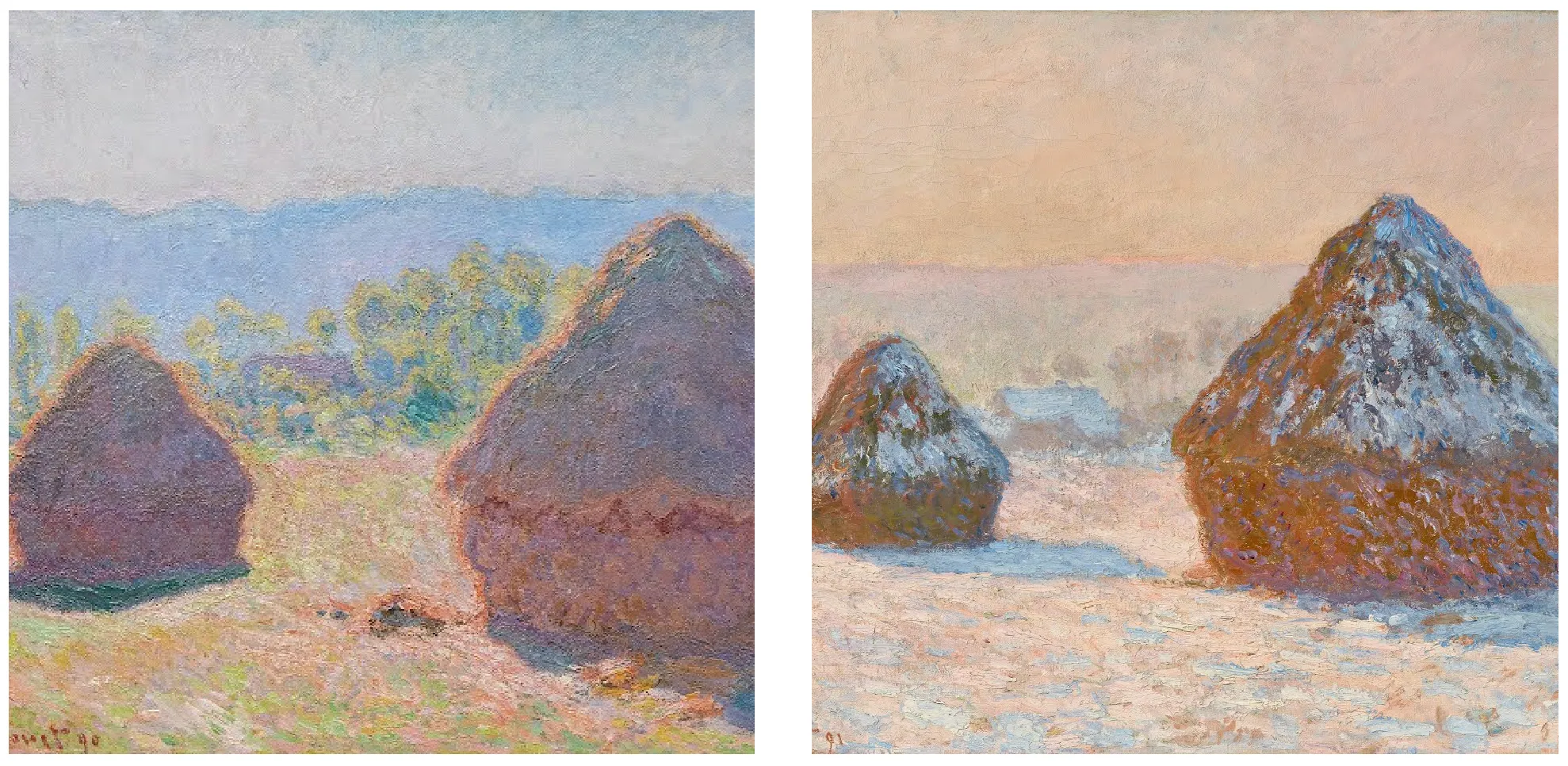
You can view the full summer composition and the full winter composition on Google Arts and Culture. Independent of the presence of snow, doesn’t it seem that Monet’s rendering of the light could only be (late) summer and winter, respectively? Additionally, the haziness of the stroke focuses the viewer on the light and the feeling of the painting. It’s more about the vibe than the specific scene. I think this is quite special!
One input to the development of Impressionism was the invention of photography. The daguerrotype was introduced in 1839, and commercial photography studios began to emerge in Paris in the 1850s. How terrifying it must have been for artists, having refined manual painting skills for years, to have their work replicated, better, in an instant, with a click of a button. Impressionism debuted in the 1863 Salon des Refusés.
Echo anything?
The Impressionists were skilled, experienced painters before they invented Impressionism. Imagine if they had given up painting and the study of light because of the emergence of photography! It was surely exciting and productive and lucrative to take photos in the 1950s, rather than paint.
Learning helped me write this blogCopy link
Since early 2023, I’ve been using AI to learn new things. Disparate skills and knowledge have come together to produce this blog post:
- Interest in learning Go led me to Hugo, which showed me the virtues of static site generation (“SSG”). This website, which I migrated from hosted Wordpress in a weekend, uses Astro, an alternative SSG framework.
- Learning Rust has built up to my current interest in GPU shaders.
- I’ve learned about art by querying LLMs during museum visits!
If I had only vibe coded everything in the past, I don’t think I would have been able to synthesize diverse knowledge into this current blog. I think this has produced better results than the counterfactual! Hopefully you don’t think this blog or website are slop. In my career, too, what I’ve learned has augmented my professional value far more than any individual tool or project I’ve built.
Sometimes I feel an urgency, or even a desperation, to build as fast as possible. I see this in others too, often most acutely in people who are most AI-pilled. I think it’s a shame to feel this way, and additionally not right. I’m betting that the right investment is still to learn, and to do many things manually.
I’d much prefer to have been an Impressionist than an early adopter of the daguerrotype.